

From The Asbestos Frontline 19th November 2026 - Report From Derek Maylor

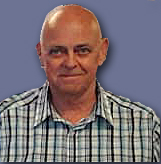 Here, Derek Maylor, CWU Retired Member Grter Merseyside Amal Branch and trustee of Merseyside Asbestos Victims Support Group; reports on a conference held by Leigh Day Lawyers on 19th November. It also covers the issue of Asbestos in Water Pipes, and the possible ingestion of Asbestos and negative health effects as a result:
 We were welcomed to the event by Daniel Easton and Richard Meeran of hosts Leigh Day & Co who introduced the impressive agenda and speakers from around the globe, Canada, Indonesia, New Zealand and Australia. The first session, whilst British made and presented, was an in depth look at a town in India whose population has been, still are,
devastated by a British asbestos company.
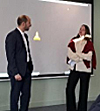 The film was made for ITV News by Sam Holder and Jess Omari and called “Inside one of India’s most toxic towns”. Kymore in India has a population of 30,000 and the report raises fresh questions about corporate accountability as residents face severe illness decades later and remain contaminated by an estimated million tonnes of asbestos waste linked to Turner & Newall, once Britain’s largest and most profitable industrial companies. Dr Muralidhar Venkiteswaran, has diagnosed
residents with mesothelioma and asbestosis over many years, dedicating his career to supporting residents, whilst knowingly risking his own life. The film was first aired September 2026 – link below (1).
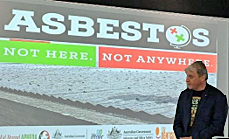 Phillip Hazelton AM, Chair of the Asbestos and Silica Safety & Eradication Council and Ban Asbestos Campaign Coordinator Union Aid Abroad (APHDA), Australia. There are 4000 asbestos related deaths per year in Australia, it needs eradicating sooner not later, cannot just kick it down the road, this saves lives and saves money. There is a high level of cross party acknowledgement and agreement of this internally but there is still a fight occasionally and very much so internationally - see Union Aid Abroad link (2). Many countries will not admit that they have an asbestos problem because then they have to take action.
The Rotterdam Convention allows Chrysotile to be traded even though the other five types of asbestos are listed and trade banned. Philip noted that:
· Over 4m global deaths this century from asbestos exposure.
· In 1924 over 1m tonnes of asbestos was traded across the world.
· 85% of the world’s asbestos fibre is now used manufacturing in Asia.
· Only Japan, South Korea, Tiwan, Brunei, Nepal and Singapore have practically banned all types.
· Many others have banned some types but not Chrysotile.
To end the world’s asbestos trade we need to expose the industry influence tactics and profits by:
· Campaigning and researching to expose them.
· Diplomatic action from countries and businesses already transitioned and trading with Asia e.g. EU/Japan/Korea etc.
· Promotion of safer substitutes.
· Seeking an update of WHO ILO advice and recommendations (3).
· Reforming the Rotterdam Convention voting procedures/GFC chemical of concern.
We also need to expose the shocking cost of continued use for those countries still using strong coalitions to continue momentum gained; we need the resources for advocacy, awareness and fighting funds for activists and proactive legal strategies against the asbestos industry.
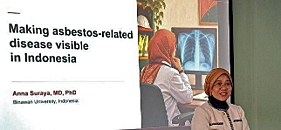 Dr Anna Suaya, Head of Scientific Development Unit of the Occupational Doctors Association of Indonesia noted that from her own home she could go online and by asbestos products within minutes – such as roofing sheets, gaskets, asbestos cloths and cable sleeves. However small steps over the last few years are promising even if that leaves a long way to go.
Asbestos-related disease is often unrecognised, or even denied. Dr Suraya once pointed out to a respected colleague that the roof of the room where they were treating a patient was itself asbestos. Competing priorities such as TB can also prevent diagnosis. Under pressure, a patient may be misdiagnosed with TB and given treatment that then appears "resistant". This limits treatment options for later patients who genuinely have TB. Even so, small gains are welcome, and raising public and clinical awareness is helping the future.
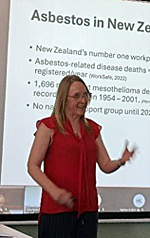 “Toxic Toys: Asbestos in Play Sand” by Dr Terri-Ann Berry, Associate Professor at Aukland University of Technology and a live current international issue because of Dr Berry and her team. Reuse and recycle sounds good, but how much is, and how many people, are exposed to asbestos fibres when trying to be environmentally friendly?
The old consensus is still hard to shake off, that “asbestos is a grandad problem”. Fibre in sand was said to be in a matrix and thus low risk, this is incorrect and her team were about to prove it. The fibre does not mix with sand grains, fibres may be stuck to a grain by moisture
for example but it still can be released when the whole “matrix” is manipulated, like a child playing with it, running cars or toy soldiers etc through it.
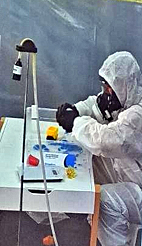 They set up a replica play area inside a Class A enclose, air pressure was monitored, all gaps sealed and so on. They purchased child’s toys, table and chair, tested for sitting and standing heights running the cars through both craft sand and moulding stand. The fully trained and PPE kitted Tester tried four different play scenarios. Swab & air test results were sent to different laboratories from different countries to be interpreted and results proved beyond doubt that asbestos fibres were being released from the play sand.
Their outstanding work immediately caused a world-wide withdrawal of play sand from shelves, home, schools, making a safer world for our children. Latest update (4).
The days final speaker was Julian Branch, Board member of Canadian NGO Prevent Cancer Now, “Asbestos Cement Water Pipes, Nuisance or Killer?. Julian found out that over 600 kilometres of the drinking water pipes in his home city were made of asbestos cement he started campaigning which has taken him around the world, both live and online. Most of these pipes have reached the end of their expected working lives, and are experiencing an increase in failures around the world.
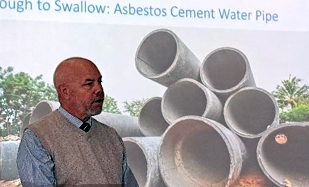 Only the United
States regulated asbestos in water since 1992 when their Environmental Protection Agency took fast action, leaving the rest of the world behind. Asbestos cement water pipes, and ingested asbestos is an international problem. Now, added to this, changes in weather, flooding and pressure on the pipe, shrinking soil and then the opposite, extremes weather/summer opposite effects on the pipe, like never before in the UK and elsewhere. Asbestos inhalation v ingestion – many say the latter is not a problem however to use the World Health Organisation’s (WHO)
advice and err on the side of caution, which the WHO term as “the Precautionary Principle”, considers that ingestion can cause peritoneal mesothelioma.
Links:
1. “Inside one of India’s most toxic towns” www.youtube.com/watch?v=EOdSX2b-grw (YouTube). 2. Union Aid Abroad-APHEDA https://apheda.org.au/.
3. World Health Organisation. (2026). Asbestos. [Online]. Fact Sheets. Last Updated: 11 August. Available at: https://www.who.int/news-room/fact-sheets/detail/asbestos. [Accessed 20 November 2026].
4. Dr Terri-Ann Berry et al. (2026). Determination of Asbestos Fibre Release Potential from Contaminated Craft Sand and Sand-Based Toys. [Online]. ChemRxiv (R). Last Updated: 29 September. Available at: https://chemrxiv.org/doi/full/10.26434/chemrxiv.15006130/v3. [Accessed 20 November 2026].
